Compare
Best WordPress cache plugin 2026: Spark Speed vs 12 alternatives
There are dozens of cache plugins for WordPress. Most of them make your site faster. The question is what else they do: where your pages are processed, what happens when an optimization breaks something, and what you pay. Here they are side by side, with measurements on a real site instead of promises.
In short
- Tested on the same site: average mobile PageSpeed score 99.8 for Spark Speed, 100.0 for WP Rocket
- Spark Speed tests risky optimizations on your own page first and can revert every change
- LiteSpeed Cache only caches pages on a LiteSpeed server
- Perfmatters and Autoptimize are not page caches: you still need another plugin next to them
Every cache plugin at a glance
Price, whether there is a real page cache inside, and where the heavy lifting happens. That last point decides whether you depend on a service from the maker, and whether your pages leave your server.
| Plugin | Page cache | From | Where optimization runs | Notable |
|---|---|---|---|---|
| Spark Speed | Yes | €49.99 per year, or monthly | Your own server | Checks its own optimizations, decision log with revert |
| WP Rocket | Yes | €49.95 per year | Server + cloud for unused CSS | Cloud features stop when the licence expires |
| FlyingPress | Yes | USD 59 per year | Server + cloud (page HTML) | Strong defaults |
| NitroPack | Yes | Free up to 1,000 views per month | Cloud | Pageview quotas |
| LiteSpeed Cache | Only on LiteSpeed or QUIC.cloud | Free | Server + QUIC.cloud | Page cache needs a LiteSpeed server |
| W3 Total Cache | Yes | Free, Pro USD 99 per year | Server | Also object and database cache |
| WP Super Cache | Yes | Free | Server | Page cache only |
| WP Fastest Cache | Yes | Free, Premium USD 49 once | Server | Simple |
| Breeze | Yes | Free | Server | Built for Cloudways/Varnish |
| Hummingbird | Yes | Free, Pro via WPMU DEV | Server | Part of WPMU DEV |
| Cache Enabler | Yes | Free | Server | Page cache only |
| Perfmatters | No | USD 29.95 per year | Server | Optimization without a page cache |
| Autoptimize | No | Free | Server | Optimization without a page cache |
Prices and terms from the makers' websites, checked on October 9, 2026. Always check the current price with the maker.
Measured: Spark Speed vs WP Rocket
On the same copy of sparkcore.io, on the same server, five pages, five Lighthouse runs per page. The same PageSpeed score; the full report, with prices and method, is on the Spark Speed vs WP Rocket page.
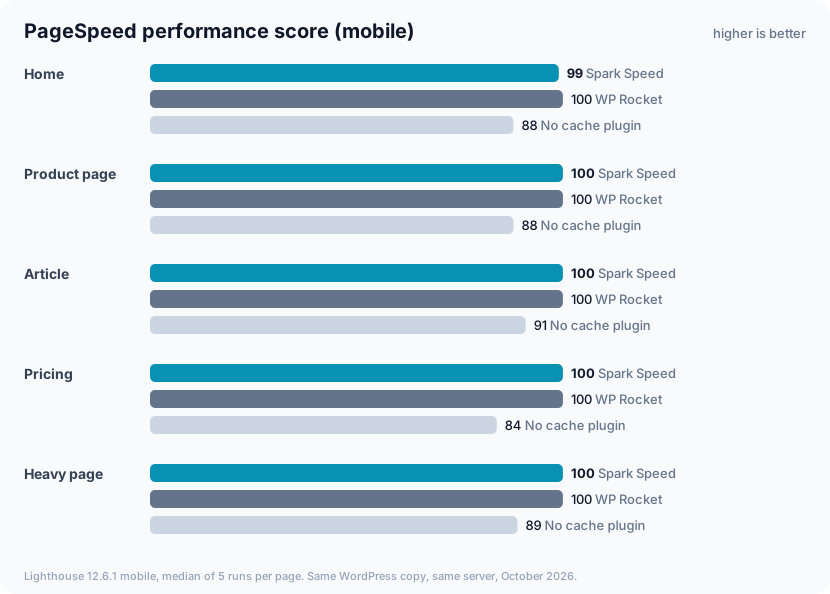
| Page | Spark Speed | WP Rocket | No cache plugin |
|---|---|---|---|
| Home | 99 (1.61 s) | 100 (1.24 s) | 88 (2.80 s) |
| Product page | 100 (1.56 s) | 100 (1.24 s) | 88 (2.81 s) |
| Article | 100 (1.21 s) | 100 (1.19 s) | 91 (2.77 s) |
| Pricing | 100 (1.55 s) | 100 (1.31 s) | 84 (2.77 s) |
| Heavy page | 100 (1.78 s) | 100 (1.35 s) | 89 (2.97 s) |
Mobile PageSpeed score, Largest Contentful Paint in brackets; median of 5 Lighthouse runs per page.
Why self-checking makes the difference
A cache plugin that optimizes aggressively scores well in PageSpeed until something breaks: a menu that does not open, a cart that does not update, a form that does not send. Most plugins leave finding and fixing it to you. Spark Speed checks every optimized page, can test risky settings in a real browser first and logs every automated change with a button to revert it.

Which plugin fits you?
If you run on LiteSpeed hosting and do not want to pay, LiteSpeed Cache makes sense. If you only want a simple page cache, WP Super Cache or Cache Enabler will do. If you want the highest score without your site quietly breaking, and without your pages going to a cloud, Spark Speed is built for you.
Switching from WP Rocket or FlyingPress? Spark Speed reads your existing exclusions and shows them as a preview first.
The cache plugin that checks itself.
Frequently asked questions
It depends on your server and what you want. In our measurement Spark Speed reached the same PageSpeed score as WP Rocket on the same site, cheaper once you have more than one site, and with an automatic test of risky optimizations before they stay on.
Not with Spark Speed, WP Rocket or FlyingPress: they do caching and optimization together. Perfmatters and Autoptimize only optimize and need a page cache next to them.
The optimizations do, the page cache does not: that needs a LiteSpeed web server or the QUIC.cloud CDN.