Compare
Spark Speed vs WP Rocket: practically the same score, far cheaper for multiple sites
WP Rocket is the best-known cache plugin for WordPress. We put it next to Spark Speed on exactly the same site, the same server and the same five pages, and measured every page five times with Lighthouse. Outcome: an average PageSpeed score of 100 for Spark Speed and 100 for WP Rocket. Between 99 and 100 on every page. The real difference is in what you pay and how much work it takes.
In short
- Average mobile PageSpeed score: 100 for Spark Speed, 100 for WP Rocket
- Five sites for €99.00 per year, where WP Rocket charges €99.95 for three
- Unlimited sites for €199.00 per year; at WP Rocket 50 sites cost €249.95
- Spark Speed checks its own work and keeps a decision log with one-click revert
- Switching takes minutes: your WP Rocket exclusions are imported
The same score, measured on the same site
Not an empty demo site, but a copy of sparkcore.io with Breakdance, Google Fonts, a consent banner and analytics, plus a deliberately heavy page with twelve large photos, a YouTube video and a Google Maps embed. WP Rocket ran with every relevant option on, including Remove Unused CSS from the WP Rocket cloud. Without a cache plugin the same site scored between 84 and 91.
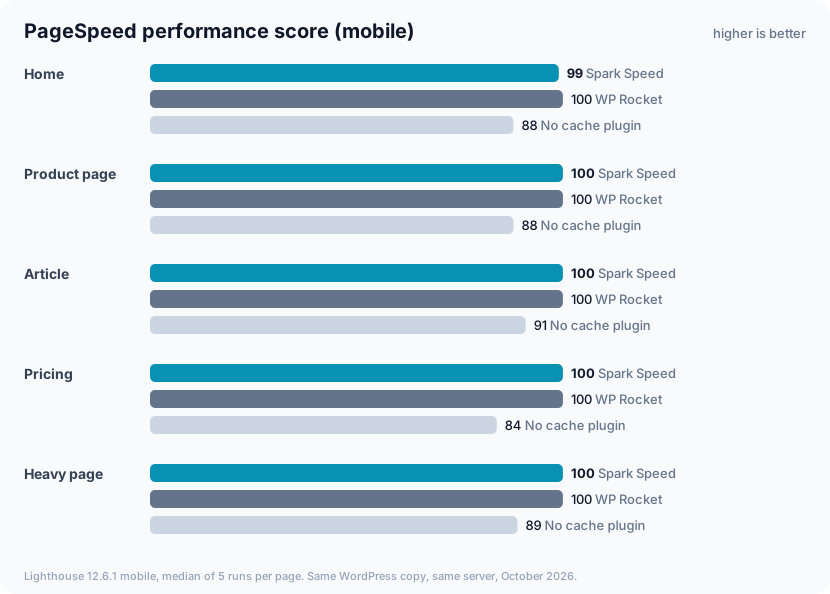
| Page | Spark Speed | WP Rocket | No cache plugin |
|---|---|---|---|
| Home | 99 (1.61 s) | 100 (1.24 s) | 88 (2.80 s) |
| Product page | 100 (1.56 s) | 100 (1.24 s) | 88 (2.81 s) |
| Article | 100 (1.21 s) | 100 (1.19 s) | 91 (2.77 s) |
| Pricing | 100 (1.55 s) | 100 (1.31 s) | 84 (2.77 s) |
| Heavy page | 100 (1.78 s) | 100 (1.35 s) | 89 (2.97 s) |
Mobile PageSpeed score, Largest Contentful Paint in brackets; median of 5 Lighthouse runs per page.
Far cheaper once you have more than one site
For a single site they cost the same. After that the gap opens fast: five sites with Spark Speed cost less than three with WP Rocket, and unlimited sites cost less than WP Rocket charges for fifty. You can also pay for Spark Speed monthly.
| Sites | Spark Speed | WP Rocket |
|---|---|---|
| 1 | €49.99 per year | €49.95 per year |
| 3 to 5 | €99.00 per year (5 sites) | €99.95 per year (3 sites) |
| 15 | €149.00 per year | €249.95 per year (Multi, 50 sites) |
| 50 | €179.00 per year | €249.95 per year |
| Unlimited | €199.00 per year | Not available (500 sites on request) |
| Monthly | From €4.99 per month | Not available |
Spark Speed prices from our store; WP Rocket prices from wp-rocket.me, checked on October 9, 2026.
Easier to manage
On activation Spark Speed recognises your stack (including Breakdance, Elementor, Divi, Oxygen, WooCommerce and FluentCart) and prepares the right exclusions. The optimizer tests risky settings in a real browser on your own pages first and keeps only what works. Every automated change is logged in a decision log and can be reverted with one click. And where WP Rocket makes the whole cache cold every ten hours by default, Spark Speed only refreshes what actually changes.

Side by side
The differences we verified in the source code of both plugins.
| Feature | Spark Speed | WP Rocket |
|---|---|---|
| Checks every optimized page before it goes live | Yes, with fallback to the original | Only on empty output |
| Tests a risky setting in a real browser first | Yes (optimizer) | No, settings apply on save |
| Finds and excludes a breaking script itself | Yes (optimizer) | Manually, with curated lists |
| Decision log with one-click revert | Yes | Plugin version rollback only |
| Refuses pages with session or login cookies and private cache headers | Yes | No |
| Whole cache goes cold every 10 hours | No, only what changes is refreshed | Yes, by default |
| Unused CSS | On your own server | Via the WP Rocket cloud |
| Object cache | Redis, Memcached, APCu or SQLite | Not included |
| Which plugin costs how many milliseconds | Yes (render profiler) | No |
| OPcache advice with concrete values | Yes | No |
| Imports WP Rocket settings | Yes, as a preview first | Not applicable |
| WP-CLI in the plugin | 17 commands | Separate add-on |
| Monthly billing | Yes | No |
Where WP Rocket is stronger
Fair is fair. On the largest content (LCP) WP Rocket was 0.27 s faster on average in our test, partly because it delays the Breakdance scripts; Spark Speed only does that once the optimizer has tested it on your site. WP Rocket also keeps caching after your licence expires, maintains long compatibility lists for hundreds of plugins and themes, has built-in integrations with Cloudflare and many hosts, and ships translations in dozens of languages. Spark Speed is fastest on Apache and LiteSpeed; if you run nginx with your own CDN, test both.
How we measured
A copy of sparkcore.io in Docker (PHP 8.3, MariaDB 11.4, OPcache on) behind a Cloudflare tunnel, so WP Rocket's cloud features could reach the site too. Lighthouse 12.6.1 in mobile mode via Chrome for Testing, five runs per page, median. For each configuration we restored the same database, fully warmed the cache and only measured once every page came from cache; for WP Rocket only after its cloud Unused CSS was active on all five pages. WP Rocket 3.23.3.3 with Remove Unused CSS, Delay and Defer JavaScript, lazy loading of images, iframes and YouTube, image dimensions and local Google Fonts. Spark Speed 0.72.0 with its recommended settings. Measured on October 9, 2026. Raw Lighthouse reports are available on request.
Switching? Leave WP Rocket in place for a moment, install Spark Speed and choose Import: you first see which exclusions will be taken over, then you deactivate WP Rocket.
Practically the same PageSpeed score as WP Rocket. Far less per site once you run more than one site.
Frequently asked questions
On the PageSpeed score, yes: in our test on the same site and server it averaged 100 with Spark Speed and 100 with WP Rocket. The largest content appeared 0.27 s earlier on average with WP Rocket. Every site is different, so always measure your own site before and after.
For one site they cost about the same. From three sites Spark Speed is cheaper, and unlimited sites cost less than WP Rocket charges for fifty. You can also pay for Spark Speed monthly.
Yes. Spark Speed recognises WP Rocket's options, even after uninstalling, and prepares your exclusions as a preview. Nothing is switched on without your approval.
No, two page caches at once get in each other's way. Use the import, then deactivate WP Rocket.